
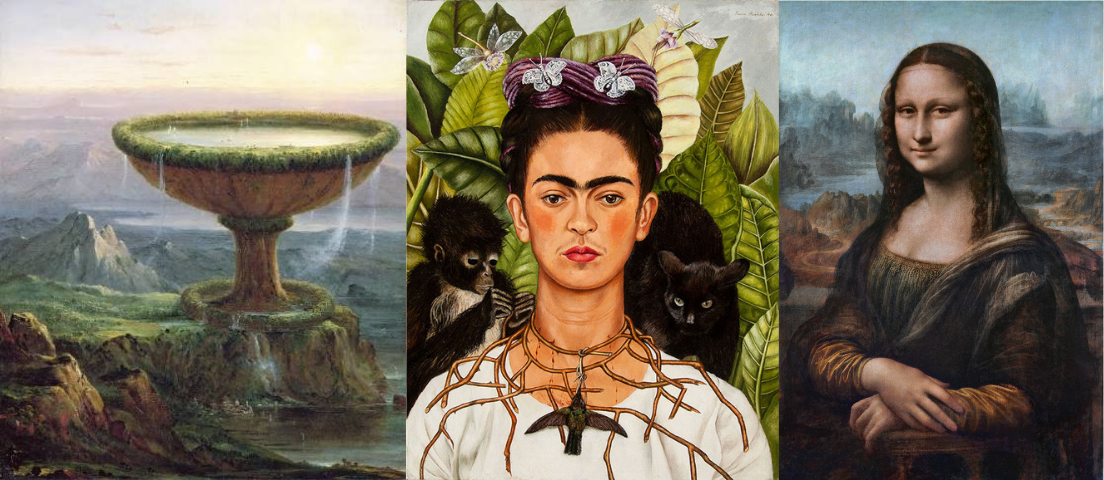
Thomas Cole (1801-1848)
The Titan's Goblet, 1833 — oil on canvas
Thomas Cole was an English-born painter who emigrated to Steubenville, OH as a young man and went on to found the Hudson River School, the first major homegrown American art movement, known for its sweeping, romantic landscapes that celebrated the country's untamed wilderness as a kind of sacred, almost divine subject. His family lived on the historic 4th Street in downtown Steubenville.
The Titan's Goblet is one of Cole's strangest and most imaginative works, a total departure from his usual realistic landscapes. It depicts an enormous stone goblet, so massive it dwarfs the mountains around it, rising up out of a valley with its own tiny ecosystem thriving on the rim.
No one has ever fully agreed on what the painting means. Some read it as an allegory for the layered ages of civilization, while others see it as a meditation on nature's power dwarfing even the grandest human achievements, given that this colossal vessel appears to have simply grown from the earth like a tree.
Unlike Cole's typical panoramic, naturalistic vistas, this small, surreal painting feels almost like a fantasy or a dream, and its ambiguity has made it a favorite subject of art historians ever since.
Frida Kahlo (1907-1954)
Self-Portrait with Thorn Necklace and Hummingbird, 1940 — oil on canvas
Frida Kahlo painted more than 55 self-portraits over her lifetime, once explaining, "I paint myself because I am so often alone and I am the subject I know best." This particular piece was created in 1940, shortly after her tumultuous divorce from fellow muralist Diego Rivera — a relationship she famously called her two great accidents in life, the other being a near-fatal bus accident at age 18 that left her with lifelong pain.
In the painting, a necklace of thorns bites into Kahlo's neck, drawing tiny beads of blood — a quiet nod to her physical and emotional suffering. A lifeless hummingbird hangs from the necklace like a pendant. In Mexican folk tradition, hummingbirds were worn as charms to bring luck in love, making its stillness here all the more pointed. A black cat crouches behind her right shoulder, poised as if to pounce on the bird, while a spider monkey (a gift from Diego himself) perches on the other side, tugging at the thorns rather than offering comfort.
Kahlo blends this raw personal symbolism with the lush, stylized foliage and vivid palette drawn from Mexican folk art, a style she embraced deeply as part of her national and cultural identity. Behind her stoic, unflinching gaze — framed by her signature unibrow — is a woman transforming pain into some of the most iconic imagery in 20th-century art.
Leonardo da Vinci (1452–1519)
Mona Lisa, c. 1503–1519 — oil on poplar panel
Leonardo da Vinci was a true Renaissance polymath (painter, engineer, anatomist, and inventor) who filled thousands of notebook pages with studies on everything from human flight to the flow of water. He carried the Mona Lisa with him for years, tinkering with it until his death, which is part of why it's considered one of the most refined works of his career.
The sitter is widely believed to be Lisa Gherardini, wife of a Florentine silk merchant named Francesco del Giocondo, hence the painting's alternate title, La Gioconda. What sets her apart is Leonardo's mastery of sfumato, a technique of blending tones so softly that outlines seem to dissolve into shadow, giving her expression its famously elusive quality — is she smiling, or not? The effect shifts depending on where you look.
Behind her, a dreamlike, imaginary landscape recedes into hazy blue mountains, adding to the painting's mysterious depth. Leonardo also broke from convention by posing her at a three-quarter turn with her gaze meeting the viewer's directly. This was a composition so influential it became the template for portrait painting for centuries after.
Today the painting hangs behind bulletproof glass at the Louvre in Paris, drawn to fame in part by a brazen 1911 theft that made headlines worldwide and cemented its status as the most recognizable painting on Earth.
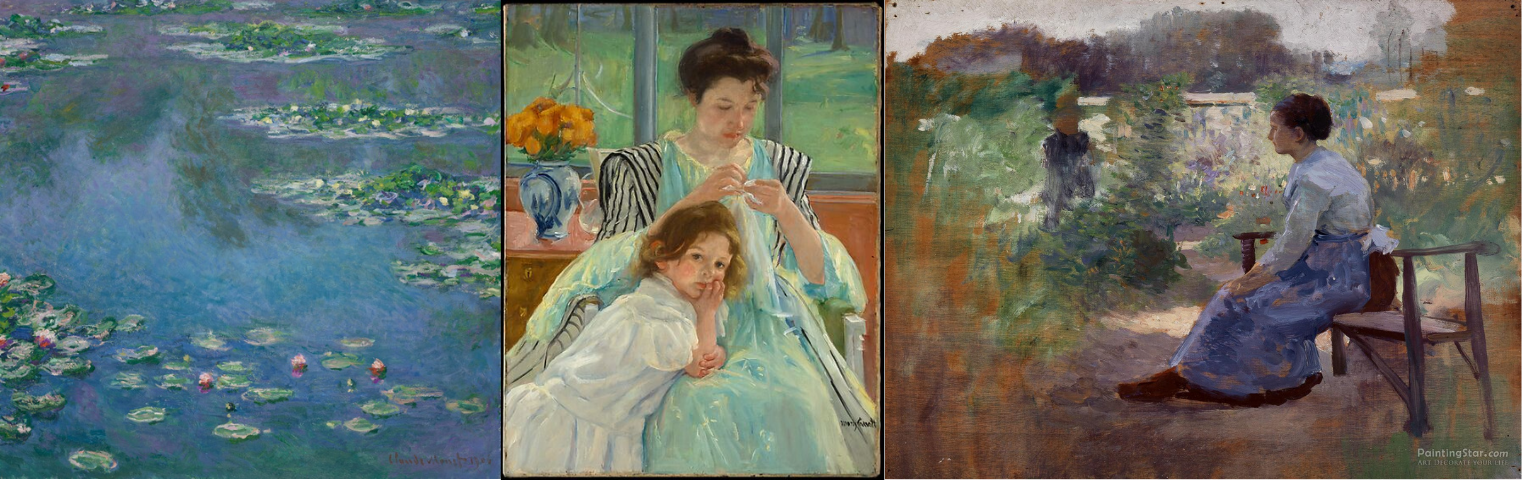
Claude Monet (1840–1926)
Water Lilies (Nymphéas), 1897–1926 — a series of roughly 250 paintings, oil on canvas
Claude Monet was the founding figure of Impressionism. The movement even takes its name from his 1872 painting Impression, Sunrise. But it was his own backyard that became his most famous subject: at his home in Giverny, France, Monet designed and obsessively tended a Japanese-inspired water garden, complete with a green footbridge and floating lily pads, purely so he could paint it.
He returned to this pond obsessively for nearly three decades, producing around 250 paintings across the series — more than any other subject in his career. As his eyesight declined from cataracts in his later years, his brushwork grew looser and his colors more abstract and intense, some paintings verging on nearly unrecognizable blurs of color that anticipated abstract art decades before it emerged.
Unlike traditional landscapes, the Water Lilies have no horizon line, no sky, and often no fixed vantage point — just water, light, and reflection filling the entire canvas edge to edge. Monet was chasing something almost impossible: not the pond itself, but the fleeting effect of light on its surface at a given moment, which meant working on multiple canvases in a single day as the light shifted.
Mary Cassatt
Young Mother Sewing, 1900-oil on canvas
Mary Cassatt was an American painter who spent much of her career in France and became the only American artist officially associated with the French Impressionists. She was especially interested in showing children as real people with distinct moods and personalities, not as perfectly posed miniature adults.
In Little Girl in a Blue Armchair, a young girl slouches across an elegant chair while a small dog sleeps nearby. Her rumpled dress, tired expression, and relaxed posture suggest that she may be bored, exhausted from playing, or simply tired of being told how to sit. Cassatt’s loose brushstrokes and vivid blue furniture make the room feel lively, even though its two occupants are resting.
The girl was the daughter of friends of fellow artist Edgar Degas, who probably helped Cassatt paint part of the room’s background. The sleeping dog, Baptiste, was Cassatt’s own Brussels Griffon and appeared in several of her paintings. By placing the girl’s informal pose inside such a fancy room, Cassatt created a portrait that still feels honest, humorous, and familiar today.
Eliphalet Frazer Andrews (1835-1915)
Woman Seated in a Garden, n.d. -oil on canvas
Eliphalet Frazer Andrews was born right here in Steubenville, Ohio, before his path took him abroad for serious training. He's best known today as a portraitist, and much of his career was spent immortalizing the faces of American history rather than painting quiet garden scenes like this one.
After a friendship with Rutherford B. Hayes drew him to Washington, D.C., Andrews established the art instruction curriculum at the Corcoran School of Art, shaping a generation of American painters. He became especially known for his presidential portraits and copies of important historical figures. His work still hangs in the White House and Capitol collections today, depicting everyone from Thomas Jefferson to Andrew Jackson.
Woman Seated in a Garden shows a different, more intimate side of Andrews, away from the formality of official portraiture. It is a relaxed outdoor scene rendered with the same careful, academic hand he brought to his presidential likenesses. It's a small but telling reminder that even portrait painters devoted to preserving the great and famous still turned, in quieter moments, to painting simple, everyday beauty.
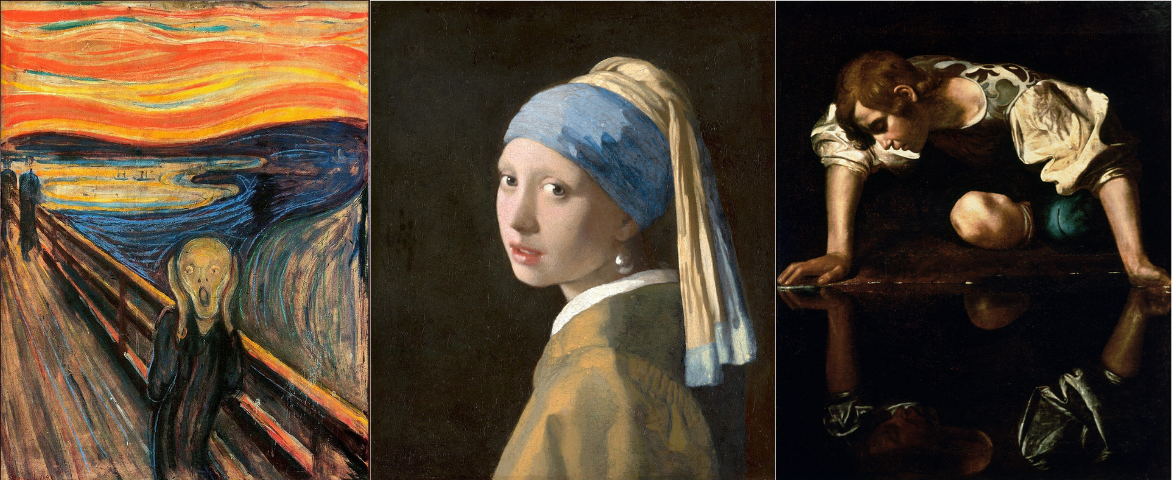
Edvard Munch (1863–1944)
The Scream, 1893 —tempera and oil crayon on cardboard
Edvard Munch's childhood was marked by illness and loss. His mother died of tuberculosis when he was five, and a beloved older sister died of the same disease when he was thirteen. That early, constant proximity to sickness and death shaped much of his art, which he described as an attempt to explain his life to himself.
Munch said the idea for The Scream came to him while walking at sunset: the sky turned "blood red," he felt a wave of anxiety, and he sensed "an infinite scream passing through nature." Rather than showing someone screaming aloud, the painting shows a figure clutching its head against a scream that seems to come from the landscape itself — the wavy, blood-orange sky and swirling blue fjord echo the figure's terror, blurring the line between the person and the world around them.
He actually made four versions of the composition across different media, along with a lithograph, and being that obsessive is part of what makes it feel like such a raw, personal outcry rather than a single finished statement.
The genderless, skull-like figure has become one of the most recognizable images in art history. It is endlessly referenced in pop culture, from Halloween masks to emojis and is often read today as a universal symbol of modern anxiety and alienation.
Johannes Vermeer (1632–1675)
Girl with a Pearl Earring, c. 1665 — oil on canvas
Johannes Vermeer worked slowly and left behind a tiny body of work (only around 34 paintings are confidently attributed to him today), likely because of his painstaking technique and the demands of running a household with 11 children. He spent his life in the Dutch city of Delft, and remarkably little is known about him personally; no letters or diaries survive, so much of what we know comes from town records and the paintings themselves.
This painting isn't technically a portrait but what the Dutch call a tronie — a study of an imagined or idealized face rather than a specific, identifiable sitter, often used to explore an expression or exotic costume.
Vermeer was a master of light, and here it does all the work: a single point of bright white paint captures the pearl's glow, while her parted lips and glance over her shoulder create an intimacy so striking the painting is often called the "Mona Lisa of the North."
Painted with a limited, precise palette and Vermeer's signature soft, almost photographic handling of light, the piece remained relatively obscure until it was rediscovered in the 19th century. This painting now hangs in the Mauritshuis in The Hague, drawing crowds much like the Mona Lisa does at the Louvre
Michelangelo Merisi da Caravaggio (1571-1610)
Narcissus, c. 1597–1599 — oil on canvas
Caravaggio lived about as dramatically as his paintings look. He was known for brawling in the streets of Rome, and in 1606 he killed a man in a fight, forcing him to flee the city as a fugitive for the rest of his short life. That same volatility and rawness runs through his art, which broke sharply from the polished, idealized style of the Renaissance in favor of intense realism and dramatic light.
Narcissus depicts the Greek myth of a beautiful young man who fell fatally in love with his own reflection, unable to tear himself away from the pool until he wasted away. Caravaggio strips the scene down to its essentials; just Narcissus and his mirrored double, locked in a tight, claustrophobic embrace of light and dark.
The painting is a showcase for chiaroscuro, Caravaggio's signature technique of stark contrasts between light and shadow, which he used to dramatic, almost theatrical effect. Here, the glowing knee of the real Narcissus and its reflection form a near-perfect circle, visually trapping the figure in his own gaze — a composition as much about psychological obsession as physical beauty.
Interestingly, the painting's attribution to Caravaggio has been debated by scholars over the years, though it's now generally accepted as his work and hangs today in the Palazzo Barberini in Rome.
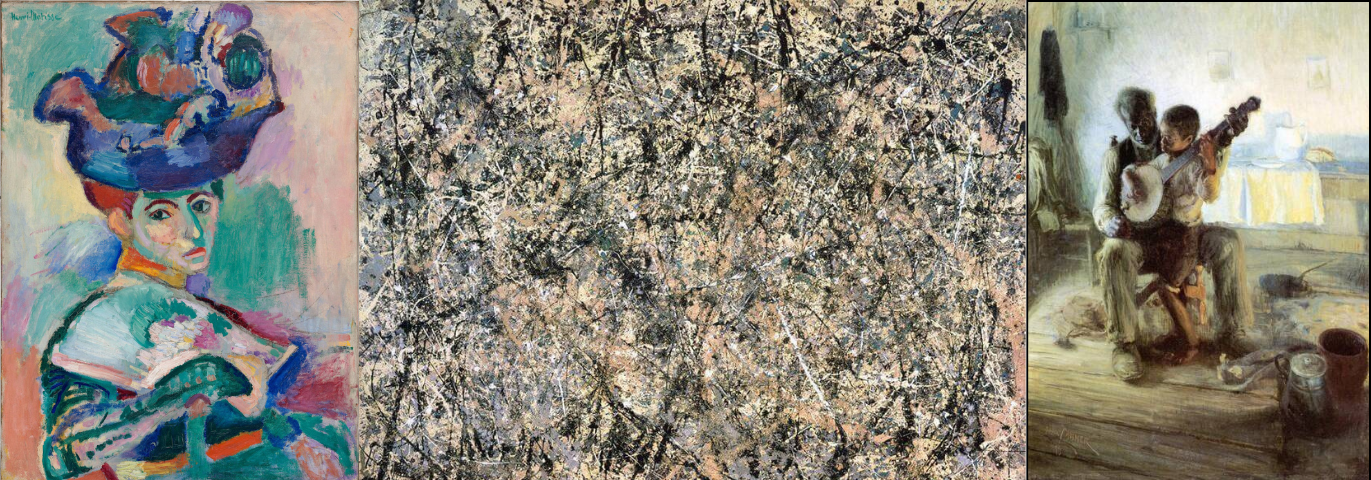
Henri Matisse (1869-1954)
Woman with a Hat, 1905 — oil on canvas
Henri Matisse first trained in law before turning to painting after a bout of illness, when his mother gave him a paint set to pass the time while recovering. The hobby quickly became an obsession and, eventually, a revolution in modern art. By 1905, he was leading a loose group of painters dubbed the Fauves, French for "wild beasts," a name coined mockingly by a critic stunned by their raw, unnatural use of color.
Woman with a Hat portrays his wife, Amélie, in an elaborate hat, but it's the color that caused an uproar: Matisse rendered her face in streaks of green, orange, and pink, with a wildly colorful hat piled on top, applying paint in loose, almost unfinished-looking brushstrokes that ignored realistic color entirely in favor of pure emotional effect.
When it debuted at the 1905 Salon d'Automne in Paris, the painting scandalized critics and audiences alike, seen as crude and unfinished. Yet its bold, expressive use of color proved hugely influential, freeing color from the job of simply describing reality and letting it carry emotion and energy on its own terms.
The painting was eventually purchased by American writer and art collector Gertrude Stein and her brother Leo, early champions of Matisse's work.
Jackson Pollock (1912-1956)
Lavender Mist: Number 1, 1950 — oil, enamel, and aluminum paint on canvas
Jackson Pollock was a central figure of Abstract Expressionism and became famous for pioneering "drip painting" — laying his canvas flat on the floor and moving around it, flinging and pouring paint from above rather than touching a brush to an upright canvas. He said this let him work "from the four sides" and be "literally in the painting," treating the act of painting itself as much a part of the work as the finished image.
Despite its title, Lavender Mist actually contains no lavender paint at all, the name was suggested by the critic Clement Greenberg, describing the overall misty, pale purple effect created by the layered whites, blues, and pale pinks, with the illusion of lavender emerging where these tones overlap. Pollock originally just numbered his works, preferring numbers over titles so viewers would approach them without a narrative to hunt for, letting the paint stand on its own.
The technique became known as "action painting," a term used to capture how Pollock's canvases record the energy, rhythm, and gesture of the artist's movements as much as any finished image. This was a radical shift in what a painting could even be, made not by careful control but the momentum of the act itself.
Henry Ossawa Tanner (1859-1937)
The Banjo Lesson, 1893 — oil on canvas
Henry Ossawa Tanner was one of the first African American artists to achieve international recognition. Born in Pittsburgh and raised in Philadelphia, he studied at the Pennsylvania Academy of the Fine Arts before moving to Paris, where he found greater artistic opportunity and freedom from the racial discrimination he faced in the United States.
Painted in 1893, The Banjo Lesson shows an older man patiently guiding a young boy’s hands as he learns to play. Tanner used warm light, earthy colors, and the figures’ close poses to create a quiet scene of trust and concentration. The banjo becomes more than an instrument—it represents knowledge, music, and tradition being passed from one generation to the next.
At a time when African Americans were often portrayed through cruel stereotypes in popular entertainment, Tanner presented his subjects with dignity, tenderness, and individuality. The painting was accepted into the prestigious Paris Salon in 1894 and later became part of the Hampton University Museum’s historic collection. Today, it remains Tanner’s best-known work and an enduring image of family, learning, and cultural connection.
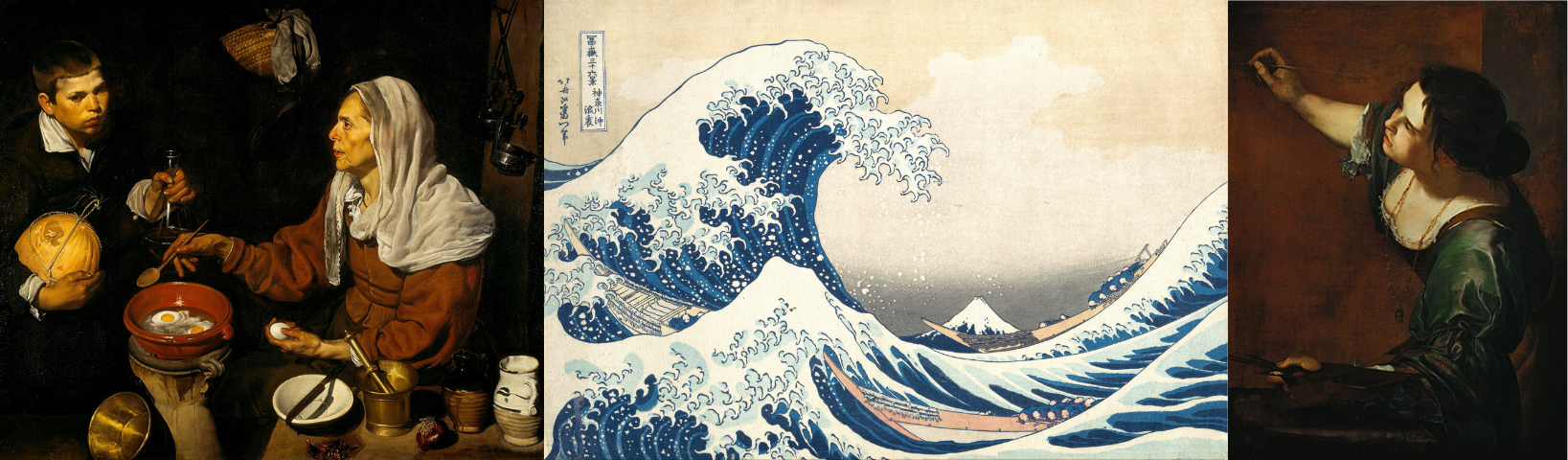
Diego Valázquez (1599-1660)
Old Woman Frying Eggs, c. 1618 oil on canvas
Diego Velázquez was only about 18 or 19 years old when he painted Old Woman Cooking Eggs. The painting is a bodegón, a Spanish kitchen scene featuring ordinary people, food, and household objects. Velázquez’s careful use of light makes the eggs, pottery, glass, and glowing coals appear remarkably realistic.
Katsushika Hokusai (1760-1849)
Under the Wave off Kanagawa, c. 1830-1832, woodblock
Katsushika Hokusai was a Japanese artist known for his colorful woodblock prints of landscapes, people, animals, and everyday life. He created Under the Wave off Kanagawa, commonly called The Great Wave, around 1830–1832 as part of his series Thirty-Six Views of Mount Fuji. Unlike a painting made by one artist with a brush, a woodblock print required a team to transfer Hokusai’s design onto carved wooden blocks and print each color separately onto paper.
The enormous wave curls above three narrow boats as their rowers race through the rough sea. Hokusai used curved lines and claw-like tips of white foam to make the water appear alive and ready to crash. In the distance, snow-covered Mount Fuji looks surprisingly small, framed beneath the wave even though it is Japan’s tallest mountain.
Hokusai’s unusual perspective creates a dramatic contrast between the moving sea and the calm, steady mountain. The print’s brilliant blues include Prussian blue, a pigment that was relatively new to Japanese printmakers at the time. With its bold color, strong shapes, and sense of motion, The Great Wave became one of the most recognizable works in Japanese art and an international symbol of nature’s beauty and power.
Artemisia Gentileschi (1593-1654)
Self-Portrait as the Allegory of Painting, 1638-1639, oil on canvas
Artemisia Gentileschi was one of the most successful painters of the Italian Baroque period, working at a time when few women could train or build careers as professional artists. She learned in her father’s workshop and eventually worked for powerful patrons across Rome, Florence, Naples, and London. In 1616, she became the first woman admitted to Florence’s prestigious Academy of the Arts of Drawing.
In Self-Portrait as the Allegory of Painting, Gentileschi shows herself leaning forward with a brush and palette, completely absorbed in her work. Her loose hair represents creative energy, the mask hanging from her gold chain symbolizes imitation, and her shimmering dress demonstrates her skill with color. Rolled-up sleeves and an apron make painting look active and physical rather than quiet or effortless.
In seventeenth-century art, Painting was traditionally personified as a woman. Because Gentileschi was both a woman and a professional painter, she could give this symbolic figure her own face—something her male contemporaries could not do. The result is both a self-portrait and a bold statement about her identity, talent, and place in the art world.
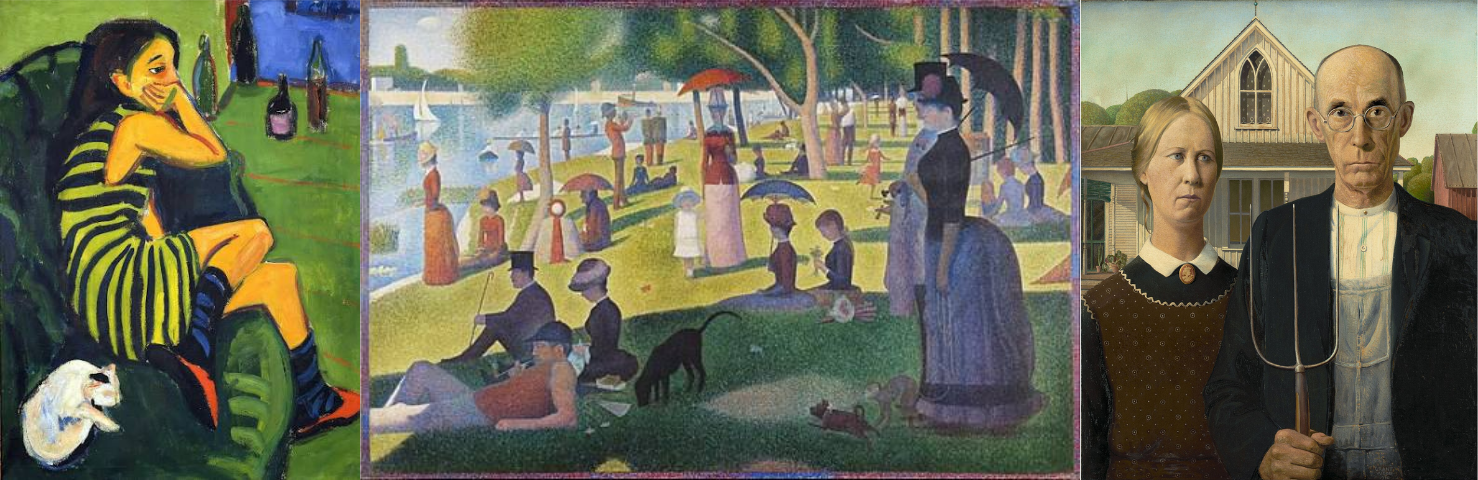
Ernst Ludwig Kirchner (1880-1938)
The Artist (Marcella), 1910 oil on canvas
Ernst Ludwig Kirchner was a German expressionist painter known for his work in the early 20th-century avant-garde movement that focused on raw emotion and psychological experiences. In The Artiste (Marcella), he employs intense colors and bold brushstrokes, using the impasto technique to create a strong expressive impact with visible paint marks.
Georges-Pierre Seurat (1859–1891)
A Sunday on La Grande Jatte, 1884, oil on canvas
Georges-Pierre Seurat created pointillism, a painting technique inspired by scientific studies of optical phenomena. He applied pure colors in small dabs, using complementary hues that blended in the viewer’s eyes to form a cohesive image. The shapes and figures in this massive painting dissolve into dots and dashes of complementary colors placed next to one another, embodying Seurat’s distinctive technique revealing a busy park on the banks of the River Seine near Paris.
Grant Wood (1891–1942)
American Gothic, 1930, oil on beaverboard
Grant Wood was known for his association with the Regionalism art movement. American Regionalism was rooted in realism, characterized by artwork that portrays authentic scenes of rural and small-town America, particularly in the Midwest and Deep South.
The ambiguity of the painting left viewers to speculate about the story behind the emotionless pair, though Wood intended to portray a positive image of a resilient father and daughter in rural America at the beginning of the Great Depression.